



Near-term outlook remains balanced, with domestic
resilience offset by geopolitical risks, crude volatility, and
inflation concerns.
Valuations have become more reasonable
post-correction, especially in large caps and
select cyclicals.
Investors are suggested to have their asset
allocation plan based on one's risk appetite and
future goals in life.
|
Indian equity markets delivered muted returns in August amid rising crude oil
prices and heightened geopolitical tensions, with broader markets
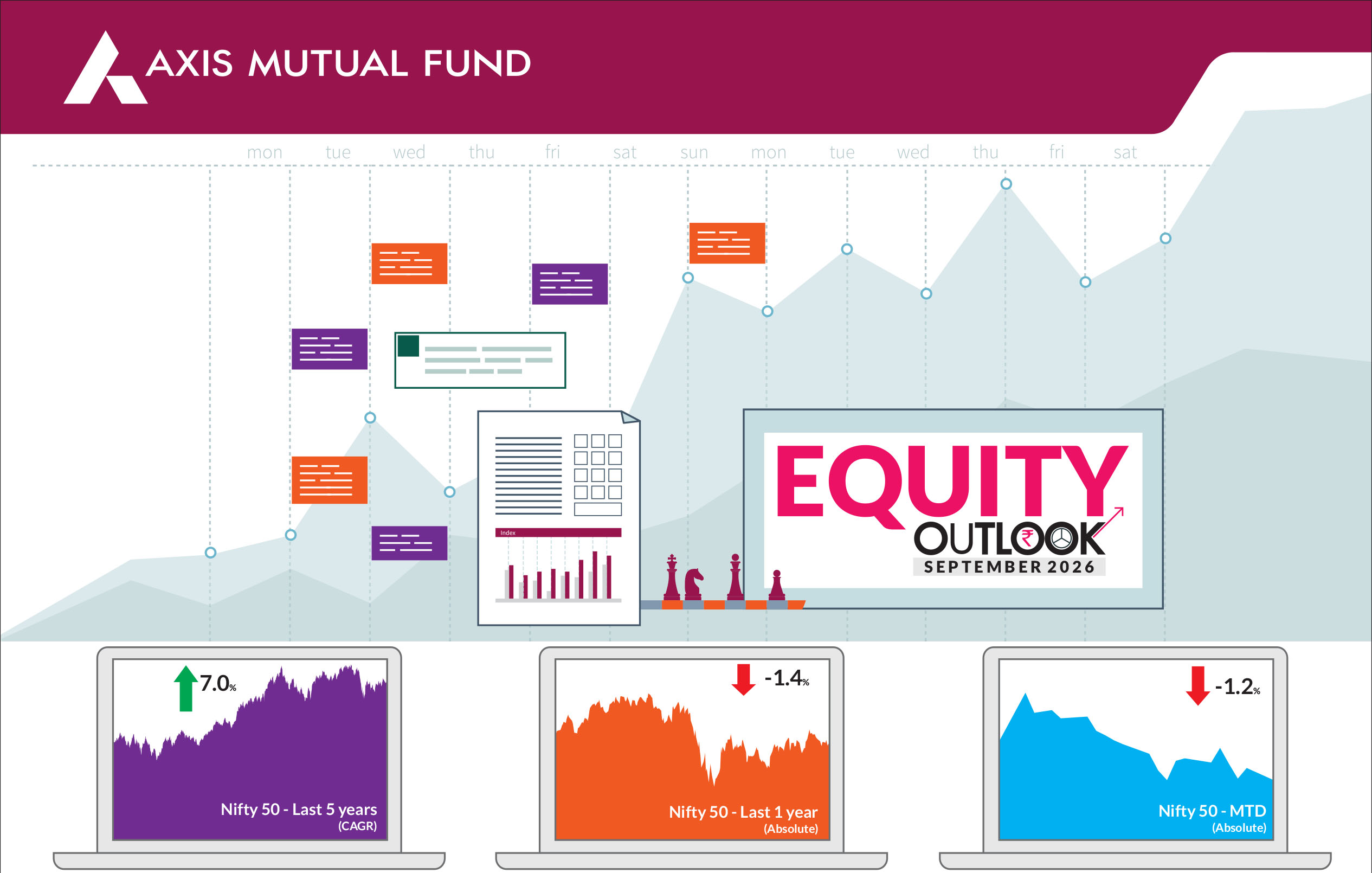
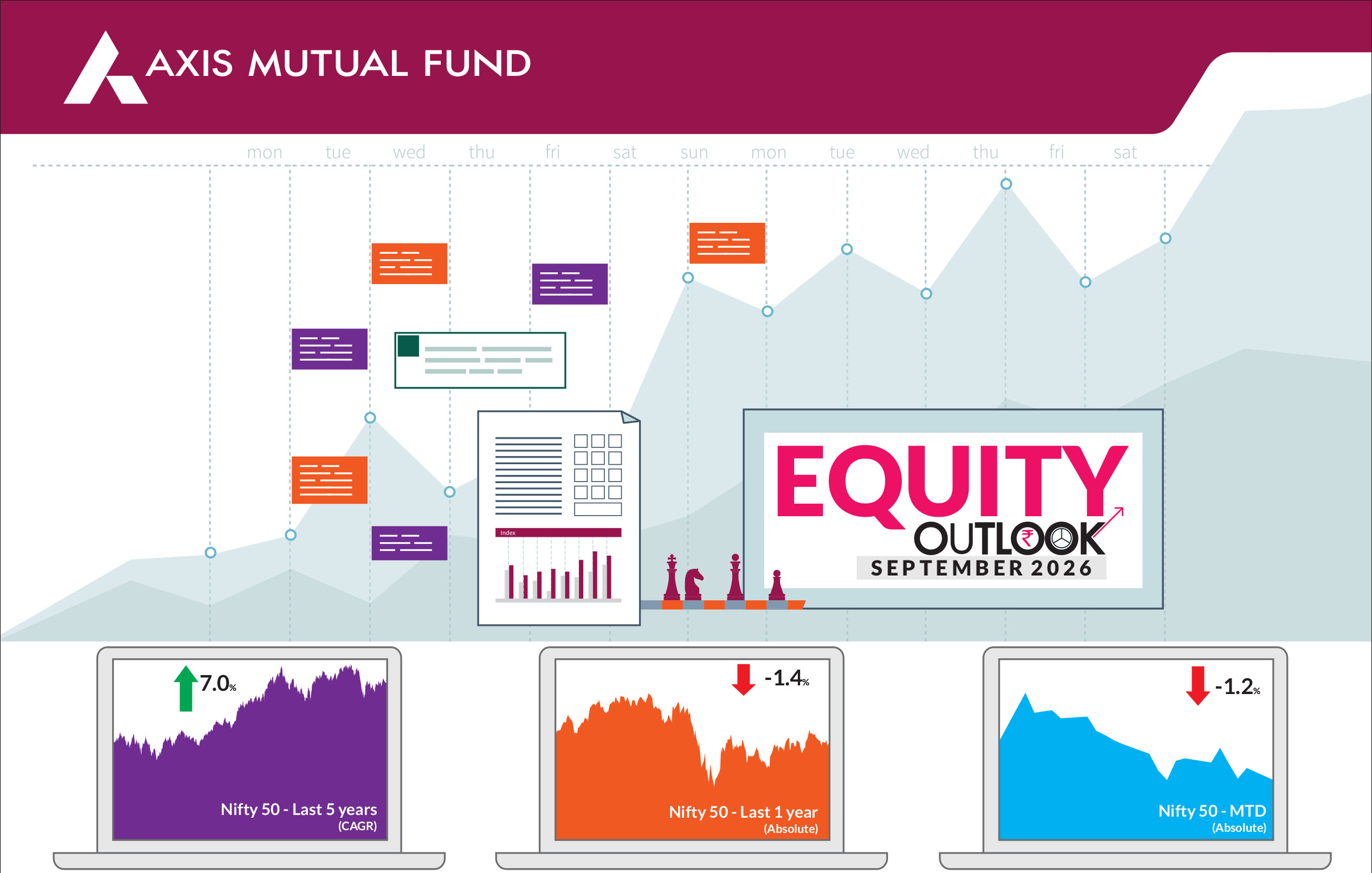
outperforming large caps. The BSE Sensex and Nifty 50 declined 1.5% and
1.2%. The broader market outperformed, with mid-cap and small-cap indices
gaining 2.1% and 3.1% respectively. Sector performance was mixed, as FMCG
and power lagged while capital goods and metals posted gains. Global equities showed divergence with some Asian markets advancing while several developed markets declined. The US market remained relatively resilient, supported by earnings strength and expectations of policy easing, while Asian markets generally outperformed developed peers. Taiwan emerged as one of the best-performing markets, driven by technology optimism, and South Korea also posted strong gains on improving export and semiconductor demand. Foreign institutional investors were net buyers during the month, infusing US$3 bn in equities and providing an additional boost to market sentiment despite ongoing concerns around crude oil prices and geopolitical developments. Domestic institutional investors poured in US$ 6.1 bn in August. Key domestic developments included changes to the derivative market closing-price mechanism, the RBI maintaining policy rates, government initiatives worth US 130 bn to support infrastructure and address inflationary pressures following sharp rise in sugar prices and measures by the US government to encourage long-duration government bond issuance. The earnings season concluded on a strong note, with healthy year-on-year earnings growth and nearly 60% of companies reporting profit surprises, led largely by commodities and financials. More importantly, demand trends remained robust across financials, consumer, pharma, industrials and textiles. Industrials and capital goods continue to benefit from a broad-based capex cycle spanning power, transmission & distribution, data centres, infrastructure and manufacturing. The bigger concern, however, is margins rather than growth. Banks continue to face pressure on net interest margins due to higher funding costs, while consumer and industrial companies are grappling with rising input costs and limited ability to fully pass these through. As a result, the key earnings debate for the remainder of FY27 is likely to centre on the pace and extent of margin recovery, which will be influenced by commodity price trends and the evolving global backdrop. |
|
OUTLOOK & POSITIONING West Asia continues to be the key global macro risk, keeping oil prices, energy costs and supply chain uncertainties elevated. At the same time, a more hawkish US rate environment has pushed bond yields and the US dollar higher, tightening global financial conditions. Meanwhile, the AI investment cycle remains a powerful structural theme, although investors are becoming more selective, favouring clear beneficiaries over companies pursuing aggressive capex without visible monetisation. As a result, oil prices, interest rates, global liquidity and the sustainability of AI-driven investments remain the key variables shaping market direction.Nonetheless, domestic fundamentals are becoming increasingly supportive after a softer FY26. Economic activity indicators remain encouraging, with strong momentum in credit growth, healthy trends in housing and consumption, and sustained strength in power demand and investment activity. Inflation normalisation is expected to lift nominal GDP growth in FY27, creating a more favourable environment for businesses and household spending. The combination of improving liquidity, stronger economic activity and a more supportive nominal growth environment provides an important foundation for the next phase of the economic cycle. India's premium vs world remains compressed, while premium vs EMs remains elevated after the correction in Taiwan and Korea. Looking ahead, we expect improving earnings momentum, relatively low valuation premiums and better FII/DII flows to support market returns despite rising equity supply and persistent global risks. At a domestic level, valuation dispersion across market caps remains elevated. While pockets of the mid- and small-cap universe continue to trade at rich valuations despite recent corrections, large caps offer a relatively more balanced risk-reward profile, supported by reasonable valuations, stronger earnings visibility and healthy balance sheets. That said, we do not view this as a large-cap-only market. Opportunities exist across market segments, but investors should adopt a selective and valuationconscious approach, focusing on businesses with sustainable earnings growth, durable competitive advantages and reasonable valuations while maintaining diversification across large, mid and small caps. Overall, we remain focused on long-term structural growth opportunities backed by domestic economic drivers rather than short-term macro trends. Our preferred themes continue to include banks, consumer discretionary, manufacturing linked businesses, domestic capex, power and transmission & distribution, industrials, defense and electronic manufacturing services (EMS). We favor companies that are well-positioned to benefit from India's ongoing investment cycle, manufacturing expansion and formalization of the economy, while maintaining resilience against global macroeconomic and commodityrelated volatility. We have been cautious on sectors such as consumer staples where margins remain vulnerable to input cost pressures or where the earnings outlook is still unclear. |
Source: Bloomberg, Axis MF Research.
